
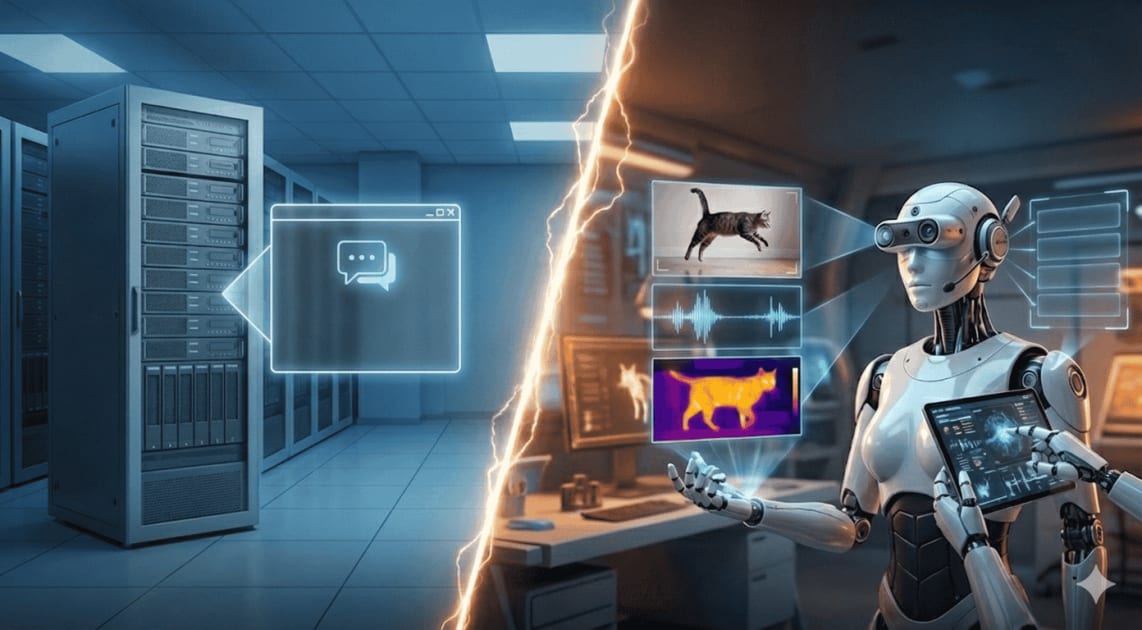
Why the Future of AI Isn’t Bigger
AI is moving beyond size. Discover how multimodal LLMs work, why smaller models are winning in production, and what this means for the future of artificial intelligence.
Multimodal LLMs & The End of "Bigger is Better": How AI Finally Gets the Real World
For the last few years, the AI world had one obsession: Size. If you wanted a smarter AI, you built a bigger model. You fed it more data, added billions of parameters, and burned through millions of dollars in computing power. The general belief was simple: The future belongs to the giants.
Well, we were wrong.
Today, the script has flipped. Two massive changes are redefining how we actually build and use AI:
- Multimodal LLMs: AI is finally learning to see, hear, and speak, not just read.
- Small Language Models (SLMs): We’ve realized that massive models are often too slow and expensive for the real world.
Here is how these two shifts are changing the game.
What Are Multimodal LLMs?
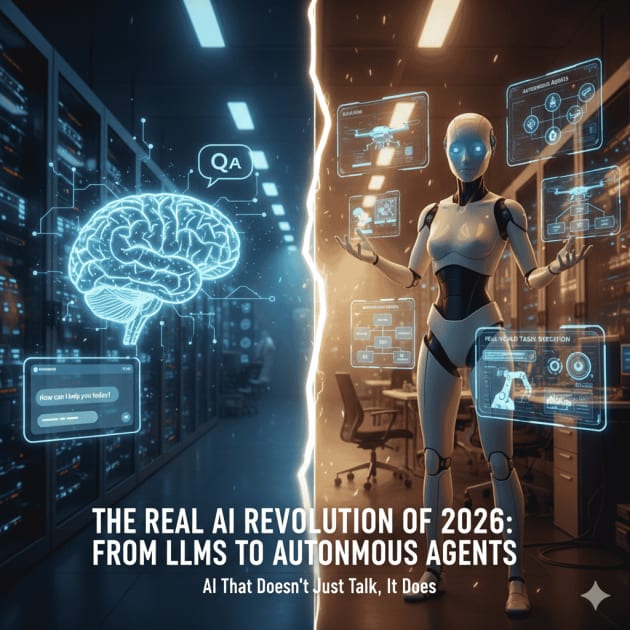
Traditional AI models—the ones we used back in 2023—were essentially "brains in a box" that could only process text. They looked at words as math (tokens) and predicted the next word.
Multimodal LLMs are different. They are designed to handle multiple types of "senses" at once:
- Text
- Images
- Audio
- Video
Instead of treating a photo and a caption as two totally separate things, a multimodal model learns that they are connected. It understands the concept of a "cat" not just by the word C-A-T, but by the shape of its ears in a photo and the sound of its meow in an audio clip. It’s the difference between reading a description of a movie and actually watching it.
Why Multimodal Understanding Matters
This is a big deal because the real world isn't made of text files. Humans communicate with messy signals—gestures, tone of voice, and visual context.
Multimodal AI unlocks capabilities that text-only models simply can't touch:
- Visual Debugging: You can show the AI a screenshot of your broken code or a picture of a leaking pipe, and it understands what it's looking at.
- Video Analysis: It can watch a security feed or a YouTube tutorial and summarize the action, not just the transcript.
- Context Awareness: It can listen to a meeting while looking at the slide deck, combining what is said with what is shown.
We are moving from "Text Generation" to true Contextual Understanding.
Why Bigger Models Are Not Always Better
There is a catch with those massive "God-tier" models: they are heavy, slow, and insanely expensive to run.
Deploying a trillion-parameter model for a simple task is like driving a Formula 1 car to the grocery store. Sure, it’s powerful, but it overheats, costs a fortune in gas, and is a nightmare to park.
This is why Smaller Models are taking over production environments. They offer:
- Speed (Low Latency): Users hate waiting 5 seconds for an answer. Small models reply instantly.
- Cost Efficiency: Running a massive model for millions of users burns through cash. Smaller models are cheap enough to be profitable.
- Privacy: Small models can run locally on your laptop or even your phone (Edge Computing), meaning your data never has to leave your device.
In 2025, a small model trained specifically for coding will beat a massive general-purpose model that knows everything about French poetry. Specialization beats generalization.
The Role of Architecture and Training Techniques
So, how are these tiny models getting so smart? It’s not magic; it’s better engineering. We aren't just making models smaller by deleting stuff. We are using smarter techniques:
- Knowledge Distillation: Imagine a genius professor (the Giant Model) teaching a bright student (the Small Model). The student learns the core concepts without needing decades of experience.
- Efficient Architecture: We are designing cleaner neural networks that do more math with less energy.
- Fine-Tuning: We train the model strictly on the data it needs (like medical records or legal docs) and ignore the rest.
This combination allows a model that fits on a standard GPU to reason almost as well as a supercomputer.
Real-World Applications Driving This Shift
Companies don't care about benchmarks; they care about products that work. In the real world, you have constraints. You can't put a massive server rack inside a smart thermostat.
This is why the industry is pivoting to smaller, multimodal models for:
- On-Device AI: Your phone organizing your photos locally without needing the cloud.
- Robotics: A robot needs to "see" and react in milliseconds, not wait for a server to think.
- Enterprise Workflows: Banks need AI that is fast, cheap, and auditable—not a creative genius that hallucinates.
What This Means for the Future of AI
The era of "One Giant Model to Rule Them All" is dead. The future is an Ecosystem of Specialists.
We will likely have a massive, super-smart model in the cloud for the really hard questions, but 99% of our daily interactions will be handled by fast, efficient, multimodal agents that live on our devices.
Conclusion: From Scale to Practical Intelligence
Multimodal LLMs represent a step toward AI systems that understand the world more like humans do—by combining language, visuals, sound, and context. At the same time, the success of smaller models highlights an important reality: practical performance often matters more than parameter count.
Together, these trends indicate a shift in how AI is evaluated and applied. The future of artificial intelligence lies not only in building larger models, but in making smarter design choices that balance understanding, efficiency, and real-world usability.