


India’s AI Revolution: Can 12 Local Models Outsmart Global Giants?
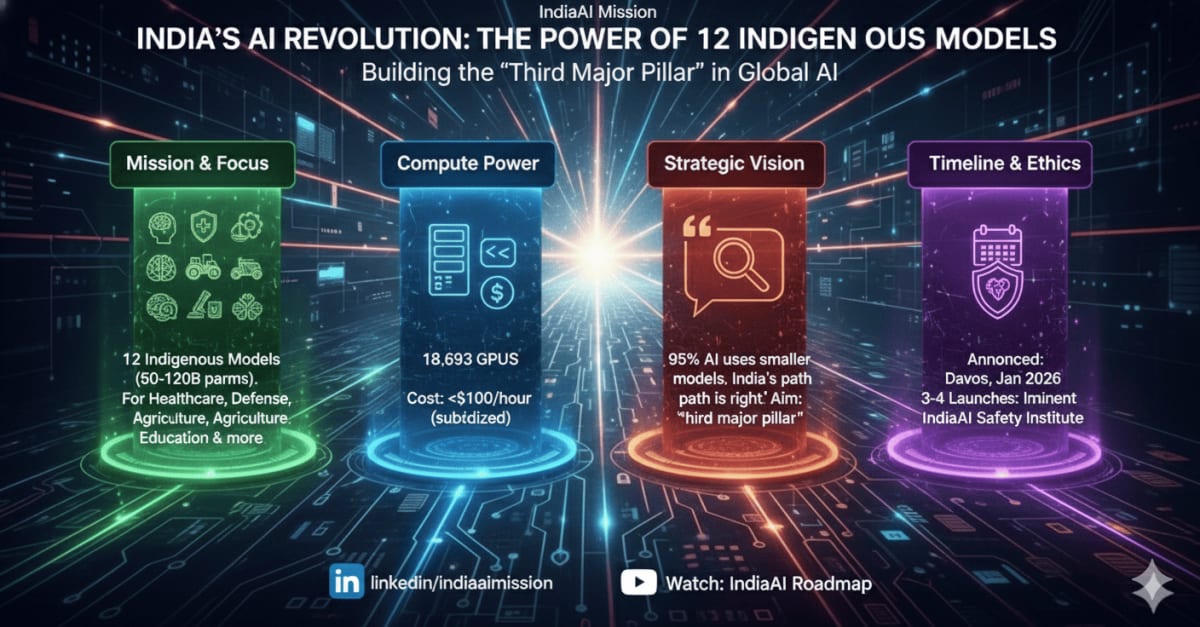
At the World Economic Forum in Davos in January 2026, IT Minister Ashwini Vaishnaw sent a clear signal to the world: India is developing 12 indigenous AI models under the ambitious IndiaAI Mission. With 3–4 launches described as "imminent," India isn't just watching the AI race—it is positioning itself as the "third major pillar" alongside the US and China.
At the World Economic Forum in Davos in January 2026, IT Minister Ashwini Vaishnaw sent a clear signal to the world: India is developing 12 indigenous AI models under the ambitious IndiaAI Mission. With 3–4 launches described as "imminent," India isn't just watching the AI race—it is positioning itself as the "third major pillar" alongside the US and China.
Why Not Just One "Giant" AI?
We are used to hearing about massive, general-purpose AI that tries to do everything. But India is taking a smarter, more human-centric path. Instead of one giant model, India is prioritizing 12 smaller, sector-specific models ranging from 50 to 120 billion parameters.
Vaishnaw pointed out a staggering truth that triggers a rethink of the industry: 95% of global AI uses actually rely on these smaller models. By focusing on these, India’s approach isn't just technologically advanced—it’s economically viable and built for the real world.
AI That Speaks Your Language
One of the biggest hurdles with global AI is that it often doesn't "get" local culture or language. India’s models are being built differently:
- Cultural Relevance: They use Indian datasets to ensure the AI understands the nuances of Indian life.
- Focus Areas: The models target critical sectors like healthcare, agriculture, defense, legal systems, climate change, and even learning disabilities.
- Language Power: For example, Sarvam AI is working on multilingual models that provide citizen services in 22 Indian languages. This ensures that AI isn't just for the elite, but for every citizen.
The Infrastructure: 18,000+ GPUs
To build these "Digital Brains," you need massive "Muscle." That muscle is provided by the IndiaAI Compute Facility, which boasts 18,693 GPUs (with 10,000 already up and running).
The most human-impacting part? The Cost. * In the global market, compute power usually costs between $2.50 and $3.00 per hour.
- India is subsidizing this cost to under $100 per hour for local startups and researchers. This makes high-end AI development affordable for the next generation of Indian innovators, providing an infrastructure that rivals the setups used to train global giants like ChatGPT.
A Safe and Ethical Future
Technology without a "soul" can be dangerous. That’s why the initiative includes the IndiaAI Safety Institute. This body is responsible for creating ethical frameworks and mitigating bias, ensuring that the AI serving the public is fair and safe.
Conclusion: India’s Moment is "Very Soon"
Six developers have been working on these models since early 2025. While we don't have a specific calendar date yet, the minister’s "very soon" indicates that India’s AI transformation is on the horizon. By focusing on what truly matters—affordability, language, and specific needs—India is proving that AI can be a tool for everyone, not just a luxury for a few.