


AI in 2026: The Biggest Shifts That Will Change How You Work, Create, and Compete
Artificial Intelligence (AI) is no longer futuristic tech — it’s now reshaping businesses, creativity, and everyday tasks. In 2026, we’re seeing real, measurable adoption of AI in enterprises, not just buzzwords. AI technologies like Retrieval-Augmented Generation (RAG), Large Language Models (LLMs), autonomous agents, and domain-specific models are driving serious innovation and ROI. If you want to stay ahead — whether you’re a business owner, innovator, developer, or creator — understanding these changes is crucial. This guide breaks down the 8 most impactful trends in easy language that’s built for engagement
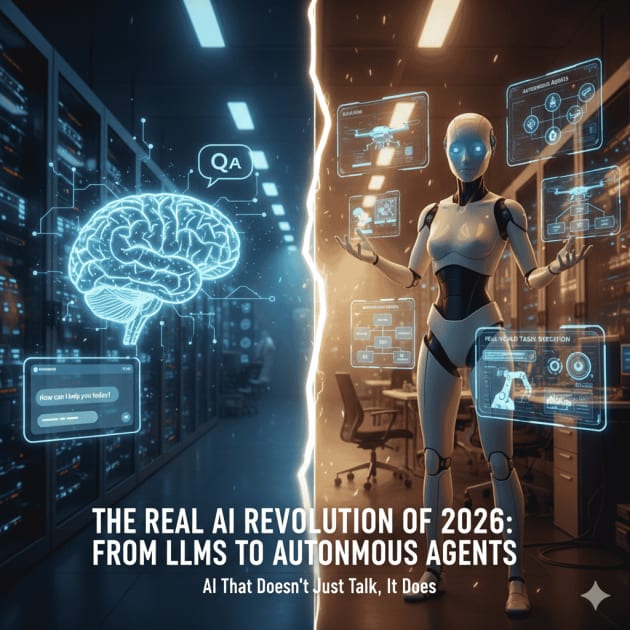
The Real AI Revolution of 2026: From LLMs to Autonomous Agents
Table of Contents
- AI Moving From Tools to Digital Workforce
- How RAG Is Changing AI for the Better
- LLMs That Understand, Reason & Act
- AI Agents: When AI Does Work for You
- Enterprise Adoption — Not Just Pilots
- Multimodal & Domain-Specific AI
- AI Governance, Trust & Compliance
- Edge AI and On-Device Models
- Infographic: AI Tech Stack in 2026
- Quick Summary & What You Must Do
1. AI Is Becoming a Digital Workforce, Not Just a Tool
AI isn’t just answering questions anymore — it’s performing tasks like a digital team member. Enterprises are now automating billing, customer support, content summarization, and reports using AI systems that handle workflows end-to-end.
This means repetitive, time-consuming work is increasingly done by AI, freeing humans for higher-value tasks. Businesses see measurable efficiency gains, making AI a core operational investment.
In 2026, AI is a workforce component — not a side project. The winners are the ones leveraging AI to execute, not just assist.
2. RAG Is the New Standard for Accurate AI Answers
Retrieval-Augmented Generation (RAG) has shifted from buzzword to baseline architecture for enterprise AI systems.
Why? Because RAG ensures AI answers are grounded in real, relevant data from your own knowledge base, not just what was learned during training. This dramatically reduces “hallucination” — inaccurate or made-up answers — and improves trust.
Today, businesses connect LLMs to internal documents, data warehouses, and enterprise knowledge to deliver factual, verifiable AI responses. This makes RAG indispensable for business value and legal/compliance needs.
3. LLMs Are Not Just Bigger — They’re Smarter and Context-Aware
Large Language Models (LLMs) have progressed beyond generic responses. While raw size once drove headlines, modern LLM usage focuses on contextual reasoning, knowledge integration, and domain performance.
In 2026, enterprises rely on LLMs that handle:
- Complex business logic
- Knowledge-intensive tasks
- Multi-step reasoning
This isn’t just tech jargon — the models powering applications are becoming domain aware, meaning they understand your industry’s vocabulary and context much better.
This is how AI moves from a curiosity to a core decision-support tool.
4. AI Agents: Intelligent Systems That Work for You
A major leap in 2026 is the rise of AI agents — systems designed not just to answer prompts, but to execute workflows autonomously.
These agents can:
- Plan multi-step tasks
- Interact with multiple systems
- Repeat complex workflows with minimal supervision
Think of AI not as a consultant, but as a junior employee you can manage. Enterprises now deploy agents for sales follow-ups, financial analysis, and cross-department coordination — shifting AI from reactive to proactive.
This is not futuristic — it’s happening now.
5. Enterprise Adoption Is No Longer Experimental
AI projects are moving from small pilots to full production systems that impact the bottom line.
Whereas many companies struggled to derive real value from AI in earlier years, 2026 sees organizations reporting measurable improvements in productivity and efficiency.
This shift reflects AI’s maturation — from “nice to have” to must-have operational tech.
6. Multimodal & Domain-Specific AI Are Taking Over
Modern AI doesn’t just understand text — it handles images, audio, documents, and structured data together. This multimodal capability powers advanced use cases like visual search, document analysis, and automated reporting.
At the same time, general-purpose models are giving way to domain-specific models trained for industries like medical, legal, financial, and manufacturing. These models deliver higher accuracy, better compliance, and faster performance.
This trend accelerates adoption because businesses get AI that truly fits their context.
7. AI Governance, Trust & Compliance Are Serious Priorities
With AI becoming mission-critical, companies must ensure systems behave ethically, safely, and in compliance with regulations.
Outcomes like bias mitigation, audit trails, data residency controls, and explainable decisions are no longer optional — they’re requirements. Regulatory frameworks and internal governance systems now play a central role in AI deployments.
This focus on trust and safety makes AI reliable — especially for sensitive sectors like healthcare or finance.
8. Edge AI & On-Device Models Unlock Privacy, Speed & Cost Savings
Not all AI happens in the cloud. In 2026, edge AI — running models directly on phones, laptops, or local servers — is becoming practical.
This approach delivers:
- Faster responses
- Better privacy
- Reduced dependency on external servers
- Lower long-term costs
On-device AI empowers personalization and secure processing for individuals and businesses alike.
Visual Section (Infographic Suggestions)
Here’s a layout you can use on your page for visuals:
Infographic: AI Tech Stack in 2026
| Layer | Description | Example |
|-------------------|-----------------------------------|----------------------------|
| LLM Core | Language reasoning & context | GPT, Claude |
| RAG Layer | Real data grounding | Vector DB + Retrieval |
| Agent Layer | Workflow automation | AI agents / orchestration |
| Governance | Safety & compliance | XAI, audit logs |
| Edge | On-device capabilities | Mobile/Local inference |
Conclusion: The AI Revolution Is Here — Are You Ready?
As we’ve explored, AI in 2026 is no longer a distant promise — it’s a practical force transforming industries, businesses, and everyday life. What used to be experimental is now strategic, and the organizations embracing modern AI tools like RAG, advanced LLMs, autonomous agents, and edge intelligence are the ones gaining real competitive advantage.
This evolution means faster work, smarter insights, and powerful automation that helps you focus on what matters most. Whether you’re a developer building the next big thing, a business owner seeking growth, or a professional who wants an edge — understanding and utilizing these technologies isn’t optional anymore — it’s essential.
Get curious. Stay informed. Start building.
Because the AI revolution isn’t coming — it’s already here.