

Stop Using RAG for Everything. Here Is When CAG Is Smarter, Faster and Cheaper
RAG and CAG are not the same thing — and confusing them is the most expensive mistake in AI architecture. This complete technical guide breaks down how each works, when to use which, and why the best production AI systems in the world use both together. Read before you build.
Retrieval-Augmented Generation vs Cache-Augmented Generation : A Deep Dive for Researchers and Practitioners
April 2026 | AI Architecture Series
Table of Contents
- Introduction and Background
- The Problem These Technologies Solve
- How RAG Works : Complete Technical Breakdown
- How CAG Works : Complete Technical Breakdown
- Mathematical Foundations
- Key Architectural Differences
- Performance Benchmarks and Metrics
- Real-World Industry Use Cases
- When to Choose RAG
- When to Choose CAG
- Hybrid RAG + CAG Architecture
- Security and Privacy Considerations
- Cost Analysis and Economics
- Scalability and Infrastructure
- Future Directions and Research Frontiers
- Conclusion
1. Introduction and Background
Artificial intelligence language models have transformed how we interact with information. However, they carry a fundamental limitation : their knowledge is frozen at the time of training. A model trained in early 2024 knows nothing about a regulation passed in late 2024, a product launched in 2025, or a scientific paper published last week.
For most enterprise and research applications, this is simply not acceptable. Doctors need current drug interaction data. Lawyers need the latest case law. Financial analysts need real-time regulatory filings. Engineers need their organisation's most recent architecture documentation.
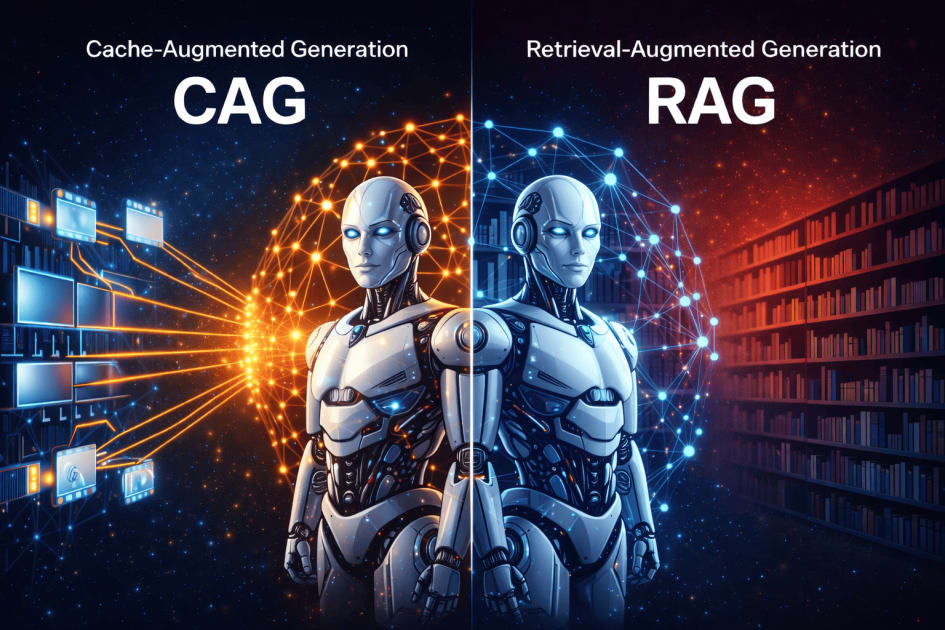
Two architectural patterns have emerged to solve this problem. RAG, which stands for Retrieval-Augmented Generation, and CAG, which stands for Cache-Augmented Generation. These are not just engineering solutions. They represent fundamentally different philosophies about how AI systems should access and use knowledge.
RAG was formally introduced in a 2020 research paper titled "Retrieval-Augmented Generation for Knowledge-Intensive NLP Tasks," published at NeurIPS 2020. The research demonstrated that combining a retriever with a generator produced answers that were more accurate, more factual, and more verifiable than a standalone language model operating from memory alone.
CAG, by contrast, is a more recent pattern that emerged organically as LLM context windows expanded from 4,000 tokens in 2020 to 200,000 tokens in 2024 and eventually to 1 million tokens as of early 2025. When a model can hold an entire technical manual in its context window, the argument for retrieval weakens considerably. CAG answers this shift with a practical and often simpler architectural approach.
This guide covers both patterns from first principles, with original technical analysis, industry use case breakdowns, and a decision framework built for researchers and practitioners who need to make real architectural choices under real constraints.
2. The Problem These Technologies Solve
To understand why RAG and CAG matter, you first need to understand the core failure modes of base language models operating without any external knowledge augmentation.
The Knowledge Cutoff Problem : Every large language model is trained on a dataset with a fixed end date. After that date, the model has no information. Ask it about a law passed six months after its training cutoff and it will either acknowledge ignorance or, more dangerously, generate a confident-sounding but entirely fabricated answer.
The Hallucination Problem : Language models generate text by predicting the most statistically likely next token given prior context. When they encounter questions they cannot answer confidently from training memory, they do not reliably say they do not know. Instead, they produce plausible-sounding but false responses. Research published in the field of AI safety has documented hallucination rates in legal citation tasks exceeding 60 percent for models operating without retrieval grounding. This is not a theoretical concern. It is a documented failure mode with real consequences.
The Private Knowledge Problem : Language models are trained on publicly available internet data. They know nothing about your organisation's internal policies, your proprietary research datasets, your customer records, or your internal codebase. Every enterprise AI application requires a mechanism to inject private and proprietary knowledge into the model's reasoning process.
The Specificity Problem : General knowledge is often insufficient for professional applications. A radiologist asking about a specific imaging protocol for a specific patient population needs precise, sourced, current information drawn from relevant clinical literature. A base model provides general textbook-level answers. Professional-grade AI requires professional-grade specificity grounded in domain-specific knowledge sources.
The Scale Problem : Even if a model were retrained continuously, the sheer volume of human knowledge generated daily makes it impossible to keep a parametric model fully current. Approximately 1.5 million scientific papers are published globally each year. Hundreds of thousands of legal filings, regulatory documents, and policy updates are produced daily across jurisdictions. No training process can keep pace with this volume in real time.
RAG and CAG both solve these problems, but through different mechanisms that make each approach superior in different contexts and use cases.
3. How RAG Works : Complete Technical Breakdown
RAG is a pipeline architecture that connects a language model to an external knowledge retrieval system at query time. It has four distinct technical components that work together in sequence.
Component 1 : The Document Ingestion Pipeline
Before RAG can function, documents must be processed and stored in a searchable form. This involves several steps that are collectively called the ingestion pipeline.
Documents in various formats including PDFs, HTML pages, Word files, database exports, and code files are first parsed into plain text. This sounds straightforward but is technically demanding in practice. A PDF containing tables, diagrams, footnotes, and multi-column layouts requires sophisticated parsing logic. Open-source tools and commercial APIs exist to handle this preprocessing step with varying degrees of accuracy depending on document complexity.
The plain text is then divided into smaller segments called chunks. Chunk size is one of the most consequential engineering decisions in building a RAG system. Too small, meaning under 128 tokens, and each chunk lacks sufficient surrounding context to be semantically meaningful when retrieved in isolation. Too large, meaning over 2,048 tokens, and chunks contain too much noise and irrelevant content, reducing retrieval precision. Research and production experience both suggest 512 to 1,024 tokens with 10 to 20 percent overlap between adjacent chunks is optimal for most use cases. The overlap ensures that information sitting at chunk boundaries is not lost between adjacent segments.
Each chunk is then passed through an embedding model. An embedding model converts text into a dense numerical vector, typically of 768 to 3,072 dimensions depending on the model architecture. These vectors are mathematical representations of semantic meaning. The critical property of a well-trained embedding model is that semantically similar pieces of text produce vectors that are geometrically close together in this high-dimensional space, even if the texts use different words to express similar ideas.
Component 2 : The Vector Database
The resulting vectors are stored in a specialised database optimised for similarity search rather than exact match lookup. Traditional relational databases search by exact match conditions or range queries on structured fields. Vector databases search by semantic similarity, finding the documents whose vector representations are geometrically closest to a query vector.
The mathematical operation at the core of vector search is Approximate Nearest Neighbour search, commonly abbreviated as ANN. ANN algorithms including HNSW (Hierarchical Navigable Small World graphs), IVF (Inverted File Index), and PQ (Product Quantization) allow systems to search across hundreds of millions of vectors in milliseconds by trading a small and configurable amount of recall accuracy for enormous gains in search speed.
Several specialised vector databases have emerged to support RAG deployments. Some are fully managed cloud services optimised for operational simplicity at the cost of flexibility. Others are open-source systems that offer more configurability and can be self-hosted for data sovereignty requirements. Some teams extend existing relational databases with vector search extensions, allowing them to manage vector search alongside structured data without introducing an entirely new infrastructure component.
Component 3 : The Retrieval Step
When a user submits a query, the query text is first embedded using the same embedding model that was used during document ingestion. This produces a query vector in the same geometric space as the document vectors. The system then searches the vector database for the top-K document chunks whose vectors are most similar to the query vector, where K is typically between three and ten depending on the application and the model's context window capacity.
A critical refinement that significantly improves answer quality is reranking. The initial top-K retrieval by vector similarity is computationally fast but semantically imprecise. Embedding similarity captures broad semantic relatedness but does not reliably rank documents by their specific utility for answering the query at hand. A reranker addresses this by taking the top-K retrieved candidates and scoring each one for precise relevance to the exact query, using a more expensive but more accurate cross-encoder model architecture. Adding a reranking step consistently improves downstream answer quality by 10 to 25 percent in controlled benchmark evaluations, at the cost of additional latency and compute.
Component 4 : The Generation Step
The top retrieved chunks are assembled into a prompt context and submitted to the language model along with the user's original query. The model generates a response grounded in the retrieved documents rather than relying solely on its parametric training memory. A well-engineered prompt instructs the model to answer only from the provided context and to acknowledge when the context does not contain sufficient information to answer the question, rather than fabricating an answer.
Advanced implementations track which specific chunks contributed to each part of the response, enabling automatic citation generation. This gives users the ability to verify claims against source documents directly, which is essential for high-stakes applications in legal, medical, and regulatory domains.
4. How CAG Works : Complete Technical Breakdown
CAG takes a fundamentally different approach to the knowledge augmentation problem. Rather than retrieving context dynamically at query time, it pre-loads a fixed body of knowledge into the model's context window before any user query is processed, and then caches this pre-loaded context at the infrastructure level to amortise its cost across many subsequent queries.
The Context Window as a Knowledge Store
Modern large language models have seen dramatic expansion of their context windows over a short period. Early GPT-class models in 2020 offered context windows of approximately 4,000 tokens. By 2024, frontier models offered context windows of 128,000 to 200,000 tokens. By early 2025, the largest available context windows reached 1 million tokens, which is approximately 750,000 words or roughly the equivalent of several hundred dense policy documents or a medium-sized codebase.
CAG exploits this capacity by pre-loading relevant documents directly into the context before any user interaction begins. A customer support system might pre-load its complete product documentation. A legal assistant might pre-load a client's full contract portfolio for a given matter. A compliance chatbot might pre-load all relevant regulatory documents for its jurisdiction. The model then answers questions by attending directly to this pre-loaded knowledge without any retrieval step.
Prompt Caching : The Infrastructure Innovation That Makes CAG Viable
The economic viability of CAG at production scale depends critically on prompt caching. Without caching, pre-loading tens of thousands of tokens of context for every single user query would be prohibitively expensive, as language model APIs charge per token processed in the input.
Prompt caching solves this problem at the infrastructure level. When the same context prefix appears across multiple API calls, the provider caches the key-value attention states computed for that prefix on their servers. Subsequent calls using the same cached prefix pay a dramatically lower cache-read price rather than recomputing those attention states from scratch. This mechanism was introduced by major API providers in 2024 and has since become a standard feature across the industry.
The economics are significant. Depending on the provider, cached token reads cost 50 to 92 percent less than uncached token processing. For a high-volume application where the same 100,000-token context is served to thousands of queries per day, prompt caching reduces the context processing cost by an order of magnitude.
Cache Invalidation and Freshness Management
The primary architectural weakness of CAG is cache staleness. When the underlying documents change, the cached context becomes outdated and may produce incorrect answers based on superseded information. Production CAG systems must implement robust cache invalidation and rebuild strategies.
Common approaches include time-based invalidation, where the cache is rebuilt on a fixed schedule such as every 24 hours for daily-updated content. Event-based invalidation triggers a cache rebuild automatically when a document is updated in the source system. Version-based invalidation hashes the current document set and triggers a rebuild when the hash changes, ensuring the cache is always consistent with the current document state. Sophisticated systems combine multiple strategies, applying the most appropriate mechanism for each category of document based on its expected update frequency.
5. Mathematical Foundations
RAG : The Retrieval and Generation Objective
RAG can be formalised mathematically. Given a user query q and a document corpus D containing documents d, the goal is to identify the k documents that maximise the probability of generating a correct and grounded answer a.
The retrieval component computes a similarity score between the query embedding e(q) and each document embedding e(d) using cosine similarity :
similarity(q, d) = (e(q) · e(d)) / (|e(q)| x |e(d)|)
The generation component then produces the answer by conditioning on both the query and the top retrieved documents :
P(a | q, d1, d2, ..., dk)
The key theoretical contribution of early RAG research was demonstrating that this joint probability can be improved by training the retriever and generator in conjunction, allowing each component to improve based on gradient signals from the other rather than being trained independently.
CAG : The Context Attention Mechanism
CAG relies on the transformer attention mechanism to selectively extract relevant information from a long pre-loaded context. The scaled dot-product attention operation is :
Attention(Q, K, V) = softmax(QK^T / sqrt(d_k)) x V
where Q is the query representation derived from the user's input, K and V are the key and value representations of the pre-loaded cached context, and d_k is the dimension of the key vectors used for scaling. The model attends to all cached content simultaneously at each layer of the transformer, weighting each segment of the context by its computed relevance to the current query token.
The computational cost of full self-attention is quadratic in context length, meaning it scales as O(n²) where n is the number of tokens in the context. This is why processing very long contexts is expensive and why prompt caching, which amortises this cost across many queries, is so important to the economic viability of CAG at scale.
6. Key Architectural Differences
Source of Knowledge : RAG pulls context dynamically from an external retrieval system at the moment a query arrives. CAG uses context that was pre-assembled and loaded before the query arrives, making it immediately available without any retrieval step.
Latency Profile : RAG adds retrieval latency to every query, typically 100 to 500 milliseconds for vector search plus any network round-trip overhead, before the language model begins generating. CAG with a warm cache adds zero retrieval latency but processes more input tokens per query.
Knowledge Freshness : RAG can serve information as fresh as the most recent index update, which can occur continuously in real time. CAG serves information as of the last cache rebuild, introducing a freshness lag determined by the cache invalidation strategy.
Knowledge Scale : RAG can retrieve from document corpora containing billions of chunks. CAG is bounded by the model's context window, currently a practical maximum of approximately 750,000 words for the largest available context windows.
Retrieval Precision vs Broad Coverage : RAG retrieves a small, targeted subset of the corpus deemed most relevant to a specific query. CAG makes all pre-loaded content available to the model simultaneously. RAG risks missing relevant content if retrieval is imperfect. CAG risks the model failing to attend to the right portion of a very long context, a phenomenon sometimes called the "lost in the middle" problem documented in research literature.
Infrastructure Complexity : RAG requires a vector database, an embedding pipeline, an ingestion pipeline, and retrieval orchestration logic. CAG requires only the language model API and a mechanism to assemble the context prompt, making it operationally simpler for teams with limited infrastructure capacity.
Explainability and Citation : RAG naturally supports citations, as the retrieved chunks are explicit, identifiable, and traceable to source documents. CAG does not natively produce citations, requiring additional prompt engineering to achieve comparable transparency.
7. Performance Benchmarks and Metrics
Retrieval Quality Metrics for RAG
RAG systems are evaluated using standard information retrieval metrics adapted from the academic information retrieval literature. Recall at K measures what fraction of all relevant documents in the corpus appear in the top-K retrieved results. Precision at K measures what fraction of the top-K results are actually relevant to the query. Mean Reciprocal Rank measures where the first truly relevant result appears in the ranked list. Normalised Discounted Cumulative Gain measures overall ranking quality, giving higher weight to relevant results that appear earlier in the ranking.
State-of-the-art RAG systems evaluated on the BEIR benchmark, which covers 18 diverse retrieval datasets across heterogeneous domains, achieve NDCG at 10 scores in the range of 0.55 to 0.65 with dense retrieval alone, improving to 0.60 to 0.70 with hybrid sparse-dense retrieval combined with reranking.
Answer Quality Metrics
Both RAG and CAG systems are evaluated on the quality of the final answers they produce. Frameworks specifically designed for evaluating RAG system quality assess multiple dimensions including faithfulness, which measures whether claims in the answer are supported by the retrieved context, answer relevancy, which measures whether the answer actually addresses the question asked, context precision, and context recall.
On standard open-domain question answering benchmarks, RAG systems with strong retrievers achieve exact match accuracy improvements of 50 to 80 percent relative to base language models operating without retrieval. This improvement is consistent across different model sizes and retrieval corpus types, indicating that the benefit of retrieval grounding is robust and generalisable.
Latency Benchmarks
In production deployments, RAG typically adds 150 to 400 milliseconds of retrieval latency before the language model generates its first output token. CAG with a warm cache adds approximately zero retrieval latency but processes more input tokens, which increases time-to-first-token proportionally to context length. CAG with a cold cache, meaning a cache miss requiring full context reprocessing, can add 1 to 5 seconds for very long contexts, which may be unacceptable for real-time user-facing applications.
8. Real-World Industry Use Cases
Legal Research Applications (RAG)
Legal AI applications represent one of the most compelling use cases for RAG. Legal corpora are extremely large, change continuously as new rulings and legislation are issued, and require precise citation to source documents for professional and ethical reasons. A legal research assistant built on RAG can retrieve from a corpus of millions of case documents, statutes, and regulatory filings, grounding every claim in identifiable source material. The alternative of pre-loading all legal knowledge into a context window is not feasible given corpus size, and the alternative of relying on a base model's parametric memory is dangerous given the hallucination risks documented in legal citation tasks.
Customer Support Systems (CAG)
Customer support knowledge bases are typically compact, updated infrequently, and serve highly repetitive query patterns. The complete support documentation for most products fits within 50,000 to 200,000 tokens. Pre-loading this documentation into context at session initialisation and caching it with prompt caching eliminates retrieval infrastructure entirely and produces consistent, fast responses. CAG is the natural fit for this use case, and the economics with prompt caching are extremely favourable given high query volumes over a stable, bounded knowledge base.
Medical Literature Search (RAG)
Clinical researchers and medical professionals need access to current literature that grows by more than a million papers per year. No context window can hold this corpus, and the knowledge changes too rapidly for a cache to be kept current without continuous rebuilding. RAG over a continuously indexed medical literature database enables retrieval of the most relevant recent publications for any clinical query, grounded in citable sources.
Compliance and Regulatory Chatbots (CAG)
Organisations operating in regulated industries often need AI assistants that can answer questions about applicable regulations, internal policies, and compliance requirements. These knowledge bases are typically bounded in size, updated at predictable intervals such as when regulations change or policies are revised, and serve highly repetitive queries from employees seeking guidance. CAG with scheduled cache invalidation aligned to regulatory update cycles is an efficient and reliable architecture for this use case.
Enterprise Knowledge Search (RAG)
Large organisations accumulate vast amounts of internal knowledge across many systems including collaboration platforms, document management systems, ticketing systems, and code repositories. The volume of this content far exceeds any context window, and it changes continuously as employees create and update documents. RAG over a unified enterprise knowledge index enables employees to query across all sources simultaneously, retrieving relevant content from whichever system holds it.
Educational Tutoring Systems (Hybrid)
An intelligent tutoring system for a fixed curriculum illustrates the value of a hybrid approach. The curriculum structure, learning objectives, and core instructional content for a given course or module are stable and bounded in size, making them well-suited to CAG. A student's specific questions about a topic, however, may require retrieval from a larger body of supplementary materials, practice problems, and explanations that exceed what can be pre-loaded into context for every session. A hybrid architecture pre-loads the core curriculum via CAG and retrieves supplementary content via RAG as needed.
Code Assistance in Software Development (Hybrid)
An AI assistant integrated into a software development environment faces a knowledge challenge that maps cleanly onto the hybrid architecture. The coding standards, architectural guidelines, and style rules for a given project are stable and compact, making them ideal for the CAG layer. The broader codebase, however, may contain millions of lines of code spread across thousands of files, which cannot fit in any context window. A hybrid system pre-loads the guidelines and the files currently open in the editor via CAG, and retrieves relevant patterns and implementations from the broader codebase via RAG.
9. When to Choose RAG
The decision to use RAG should be driven by specific, verifiable properties of your use case rather than by the relative prominence of either approach in current discourse.
Choose RAG when your knowledge base is too large for any context window. If your corpus contains millions of documents, terabytes of text, or a codebase with tens of millions of lines of code, no context window can hold it. RAG is the only viable approach to accessing this knowledge in an AI system.
Choose RAG when your knowledge changes continuously or unpredictably. If your knowledge base is updated hourly with news feeds or financial data, or daily with new regulatory filings or research publications, a retrieval system querying a live index is far more practical than a cache that must be rebuilt on every change. The cost and latency of continuous cache rebuilding make CAG impractical for rapidly changing corpora.
Choose RAG when citations and verifiability are non-negotiable. In legal, medical, financial, and regulatory applications, every factual claim must be traceable to a specific source document. RAG architectures make this natural because the retrieved chunks are explicit, identifiable, and can be presented directly to users alongside the generated answer.
Choose RAG when query patterns are broad and unpredictable. If users can ask questions spanning an enormous range of topics within your domain, retrieval ensures the system can surface relevant information even for queries that were never anticipated at system design time. A static context pre-loaded with a curated knowledge selection will inevitably miss relevant content for unanticipated query types.
Choose RAG when hallucination risk is unacceptable and must be actively mitigated. Grounding language model responses in retrieved documents significantly reduces hallucination rates because the model is constrained to reason from explicit retrieved evidence rather than generating from statistical associations in its training weights.
10. When to Choose CAG
Choose CAG when your knowledge base is compact and changes slowly. If your complete relevant knowledge base fits within 100,000 tokens and is updated at most weekly or monthly, pre-loading it into context eliminates retrieval infrastructure entirely and produces consistently fast, reliable responses.
Choose CAG when response latency is a hard constraint. Real-time user-facing applications where users expect sub-second responses cannot tolerate 200 to 500 milliseconds of retrieval overhead added to every query. CAG with a warm prompt cache achieves first-token latency bounded only by the language model's own generation speed.
Choose CAG when infrastructure simplicity is a priority. Not every team has the engineering capacity to build and maintain a vector database, an embedding pipeline, an ingestion pipeline, and retrieval orchestration logic. CAG requires only a language model API and a mechanism to assemble the context, making it accessible to smaller teams working with tighter resource constraints.
Choose CAG when query patterns are predictable and repetitive. When the universe of likely queries is well understood and bounded, as in customer support or employee policy Q&A, pre-loading the relevant knowledge base is efficient, cost-effective, and operationally simple.
Choose CAG for maximum cost efficiency at stable, high query volumes. With prompt caching enabled, the marginal cost of serving each additional query against a pre-loaded context is dramatically reduced compared to uncached processing. For applications serving thousands of queries per day against a knowledge base that changes infrequently, prompt caching makes CAG the more economical architecture by a substantial margin.
11. Hybrid RAG + CAG Architecture
The most sophisticated production AI systems do not make a binary choice between RAG and CAG. They design architectures that allocate each type of knowledge to the approach best suited to its properties.
The Core Design Principle
Knowledge can be classified on two axes : how frequently it changes, and how large the total volume is. Knowledge that is stable and compact belongs in a context cache. Knowledge that is dynamic, large, or unpredictable in relevance belongs in a retrieval system. A well-designed hybrid architecture routes each category of knowledge to the appropriate mechanism.
The CAG Layer : Stable Context
The CAG layer holds knowledge that is stable across many queries and fits within the available context window. This typically includes user preferences and profile information, system instructions and behavioural guidelines, session context and conversation history from the current session, core policy documents and compliance rules applicable to all queries, and application-specific background knowledge that is always relevant regardless of the specific query.
This layer is pre-loaded at session initialisation and persists across multiple turns of conversation. With prompt caching, this context is computed once per cache lifetime and reused across all queries in the session at minimal marginal cost.
The RAG Layer : Dynamic Context
The RAG layer handles knowledge that changes frequently, exists at a scale exceeding the context window, or is only sometimes relevant depending on the specific query. This typically includes recently published documents, large reference corpora, specific records retrieved from databases in response to query-specific filters, and technical documentation that changes with each product or regulatory release cycle.
This layer is invoked selectively at query time, retrieving only the content that is relevant to the specific question being asked rather than loading all potentially relevant content into every query context.
Hybrid Example : A Research Literature Assistant
A research assistant designed to help scientists explore a large body of scientific literature illustrates the hybrid architecture concretely. The CAG layer holds the researcher's stated areas of interest, their current research project summary, methodological preferences they have expressed in previous sessions, and institutional access permissions. The RAG layer retrieves from a continuously updated corpus of scientific publications indexed by the system. When the researcher asks a question, the system retrieves the most relevant recent papers for that specific query and injects them into the context alongside the stable researcher profile from the CAG layer. The result is a system that is both contextually aware of the researcher's background and current with the latest literature.
Hybrid Example : A Financial Analysis Assistant
A financial analysis assistant for institutional use might implement the CAG layer to hold the analyst's coverage universe, their firm's analytical frameworks and house views, applicable regulatory constraints for their jurisdiction, and the current session context including previously discussed positions. The RAG layer retrieves from a continuously updated corpus of regulatory filings, earnings transcripts, economic data releases, and news items relevant to the specific securities or markets being analysed. Neither approach alone would serve this use case adequately.
12. Security and Privacy Considerations
Security considerations are often underweighted in architectural discussions about RAG and CAG, but they are critical for responsible enterprise and research deployments.
RAG Security Considerations
Prompt injection through the retrieval pathway is a significant and underappreciated attack vector. An adversary who can influence the content of documents indexed in the retrieval corpus can inject malicious instructions that the language model may follow as if they were legitimate system instructions. Mitigations include strict input sanitisation before indexing, allowlisting of trusted document sources, adversarial robustness testing during system validation, and prompt templates designed to be resistant to injection from retrieved content.
Access control enforcement in RAG systems is complex and consequential. If the retrieval corpus contains documents with heterogeneous access permissions, the retrieval system must enforce these permissions at query time, ensuring that users cannot retrieve documents they are not authorised to view simply by asking questions that happen to match those documents. Failures in access control enforcement create serious data leakage risks in multi-user deployments.
CAG Security Considerations
Context poisoning is the CAG equivalent of prompt injection. If malicious or inaccurate content is introduced into the pre-loaded context, it influences all responses generated against that context. Unlike retrieval-based injection which is query-specific, context poisoning affects every query served against the poisoned cache, potentially at scale. Strict governance over what enters the CAG context, including content review processes and integrity verification, is essential.
Data transmission and residency concerns are particularly salient for CAG deployments in regulated industries. When sensitive documents are loaded into a language model's context, that data is transmitted to and processed by the model provider's infrastructure. For healthcare data, financial data, and data subject to jurisdiction-specific privacy regulations, this requires careful contractual agreements with providers, data processing agreements where applicable, and potentially on-premises or private cloud model deployments for the most sensitive categories of information.
13. Cost Analysis and Economics
Understanding the cost structure of each architecture is essential for making production decisions at scale, particularly as AI infrastructure costs can become significant at high query volumes.
RAG Cost Components
Embedding costs apply at ingestion time for every document chunk added to the corpus, and at query time for every user query that must be embedded before retrieval. For large corpora, the one-time ingestion embedding cost can be substantial, though it is amortised over the useful lifetime of the index before the next reindex cycle. Per-query embedding costs are typically small relative to language model generation costs.
Vector database costs vary significantly by deployment model. Managed cloud vector database services charge per query unit and per stored vector, with costs scaling with both corpus size and query volume. Self-hosted open-source vector databases eliminate per-query charges but introduce operational overhead and infrastructure costs for the underlying compute and storage resources.
Language model inference costs in RAG are affected by the retrieved context added to each prompt. If each RAG response includes 3,000 tokens of retrieved context, this adds directly to the input token count charged by the language model provider, multiplied by every query in the system's lifetime.
CAG Cost Components
Without prompt caching, CAG is uneconomical at scale. Pre-loading 50,000 tokens of context for every query at standard input token pricing would make even moderate query volumes prohibitively expensive.
With prompt caching, the economics change dramatically. The initial cache write costs at the standard uncached input token rate. All subsequent queries served against the cached context pay only the cache read rate, which is 50 to 92 percent lower depending on the provider. For a high-volume application serving a stable knowledge base, this reduction represents substantial cost savings that can make CAG significantly more economical than RAG at comparable quality levels.
The crossover point where CAG becomes more economical than RAG depends on the cache hit rate, the query volume, and the relative pricing of the components. For applications with very high cache hit rates and stable knowledge bases, CAG with prompt caching can reduce total AI infrastructure costs by 60 to 80 percent compared to an equivalent RAG system.
14. Scalability and Infrastructure
Scaling a RAG System
RAG scales horizontally at each layer of the pipeline. The vector database scales by sharding the index across multiple nodes, with distributed search federating queries across shards and merging results. The embedding pipeline scales by parallelising document processing across multiple workers, which is straightforward given that chunk embedding is an embarrassingly parallel workload. The retrieval layer scales by replicating the query service to handle increased query concurrency.
The primary scaling challenges specific to RAG are index freshness at scale, meaning updating a very large index quickly when source documents change, and maintaining low retrieval latency under high concurrent query loads. Both are active areas of engineering investment in the vector database ecosystem.
Scaling a CAG System
CAG scales primarily through the underlying language model infrastructure, which is managed by the model provider in API deployment scenarios. The main scaling constraint specific to CAG is GPU memory for the key-value cache when operating at high concurrent session counts. Each concurrent session with a long pre-loaded context requires dedicated GPU memory for its KV cache, creating a trade-off between context length, concurrency, and hardware cost that must be carefully managed in self-hosted deployments.
For teams using managed API services with built-in prompt caching, much of this complexity is abstracted away by the provider, allowing engineering focus to remain on application logic rather than infrastructure management.
15. Future Directions and Research Frontiers
Expanding Context Windows and Their Implications for CAG
The trajectory of context window expansion over the past five years has been steep and shows no sign of plateauing. Research into efficient attention mechanisms, including linear attention variants, sparse attention patterns, and hardware-optimised implementations of standard attention, is pushing the practical boundaries of context length upward. If context windows reach 10 million or 100 million tokens within the next few years, the boundary between CAG and RAG will shift substantially, with CAG becoming viable for knowledge bases that today would require retrieval infrastructure.
End-to-End Trainable RAG
Current RAG systems typically use embedding models trained for general semantic similarity, which is a proxy for retrieval utility rather than a direct measure of it. Research into end-to-end trainable RAG, where the retriever is trained jointly with the generator to maximise downstream answer quality rather than embedding similarity, has shown promising results in academic settings. Wider adoption of these techniques in production systems could yield significant accuracy improvements, particularly for domain-specific applications where general-purpose embedding models underperform.
Agentic and Multi-Step RAG
Static RAG retrieves once per query. Agentic RAG systems allow the model to iteratively retrieve additional information during multi-step reasoning processes. If the first retrieval does not provide sufficient information to answer the query confidently, the agent formulates a refined query and retrieves again, continuing until it has accumulated sufficient evidence. This is particularly powerful for complex research tasks requiring synthesis across multiple sources and reasoning steps, where a single retrieval pass is insufficient to gather all relevant information.
Multimodal Retrieval and Augmentation
Current RAG systems are predominantly text-based. Emerging work extends retrieval to multimodal corpora, enabling systems to retrieve images, diagrams, audio transcripts, video segments, and structured data tables alongside textual content. As language models become natively multimodal, the ability to retrieve and reason across heterogeneous content types opens significant new application domains including medical imaging, engineering design review, and scientific figure analysis.
Compression and Distillation Approaches for CAG
A promising research direction for improving CAG involves learning compact representations of large document sets that preserve the semantic content necessary for downstream question answering while occupying far fewer tokens than the original documents. Rather than loading 200,000 tokens of raw text into context, a learned compression of 20,000 tokens might capture the same answerable knowledge with high fidelity. Work on query-aware summarisation, recursive document distillation, and learned compression techniques is directly applicable here.
Adaptive Routing Architectures
Future production systems are likely to incorporate dynamic routing that decides at query time whether to use RAG, CAG, or a hybrid approach based on properties of the specific query. A routing classifier could estimate whether the query is likely to be answerable from pre-loaded cached context alone, or whether retrieval is likely to be necessary for an accurate response. This would allow a single system to optimise for both latency and accuracy dynamically, without requiring the system designer to make this trade-off statically at architecture time.
16. Conclusion
RAG and CAG are two of the most consequential architectural patterns in applied AI today. They address the same fundamental limitation of large language models, which is that parametric training knowledge is static, incomplete, and inevitably outdated, through mechanisms that are distinct enough to make each approach clearly superior under specific conditions.
RAG solves the knowledge augmentation problem through dynamic retrieval : querying a live, continuously updated index at the moment a question arrives and grounding the model's response in explicitly retrieved evidence. This makes it the right architecture when knowledge is large, evolving, diverse, or must be citeable and verifiable. It is operationally complex but provides accuracy, freshness, and scalability that no context-based approach can match for very large or rapidly changing corpora.
CAG solves the same problem through intelligent pre-loading and caching : assembling the relevant knowledge base before queries arrive and exploiting prompt caching to amortise the cost of that pre-loading across thousands of queries. This makes it the right architecture when knowledge is compact, stable, and queries are repetitive and predictable. It is operationally simpler, lower in latency, and highly cost-efficient when the economics of prompt caching are properly applied.
The hybrid architecture, which is the approach most commonly found in sophisticated production systems, recognises that most real-world knowledge bases are not uniformly large or uniformly stable. Different categories of knowledge have different properties. The hybrid design routes each category to the mechanism it is best suited for : stable, bounded knowledge to the cache layer, and dynamic, large, or query-specific knowledge to the retrieval layer.
Several broader conclusions are worth stating explicitly for researchers and practitioners considering these architectures.
First, the choice between RAG and CAG is not primarily a technological question. It is a question about the nature of your knowledge base : its size, its rate of change, and the predictability of the queries it must answer. Answering these questions about your specific use case is more important than any general claim about which architecture is superior.
Second, the economic analysis of these architectures matters and changes with scale. At low query volumes, the infrastructure cost of RAG may be acceptable even for use cases that are well-suited to CAG. At high query volumes over stable knowledge bases, the cost savings from prompt caching make CAG substantially more economical. These calculations should be made explicitly rather than assumed.
Third, security and privacy considerations are not afterthoughts. They are architectural constraints that must be built into the design from the beginning. Both RAG and CAG introduce specific security challenges that differ from base model deployments, and both require deliberate mitigation strategies appropriate to the sensitivity of the knowledge being managed.
Fourth, the frontier is moving. Context windows are expanding, retrieval techniques are improving, and multimodal capabilities are broadening the scope of what both approaches can handle. Architectural decisions made today should be revisited as these capabilities evolve, and systems should be designed with the flexibility to incorporate improvements as they become available.
The researchers and practitioners who will build the most effective AI systems over the next decade are those who approach these architectural choices empirically, with clear thinking about the properties of their specific knowledge, the requirements of their specific users, and the constraints of their specific operational context. The frameworks and analysis in this guide are intended to support that thinking, not to replace it.