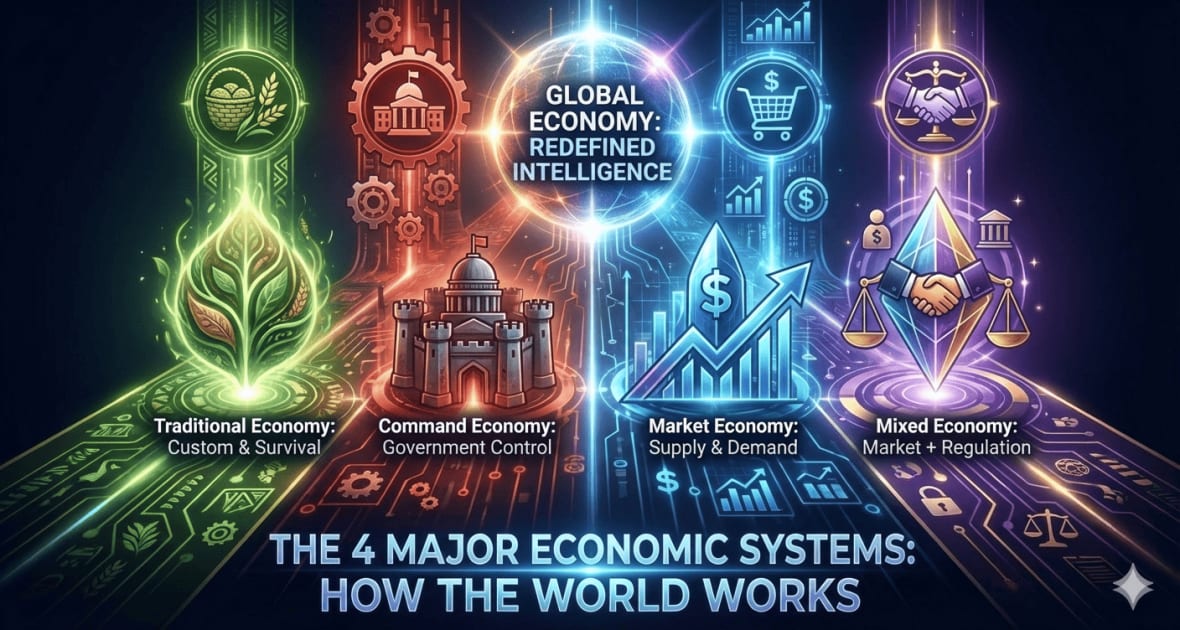

Why Capitalism, Socialism, and Communism Still Matter in Today’s World
Understand the real difference between capitalism, socialism, and communism. This guide explains how each system works, who controls resources, and why these ideologies still matter today.
Three massive ideas. Endless Twitter arguments. But what do these systems actually look like when you turn off the news and look at real life?
We hear words like "Capitalism," "Socialism," and "Communism" thrown around constantly. Politicians use them as weapons, and headlines use them as clickbait. But most of the time, people are shouting these words without actually agreeing on what they mean.
At their core, these aren't just boring textbook terms. They are simply three different ways a society answers the same basic questions:
- Who owns the stuff? (Factories, land, businesses).
- Who calls the shots? (Who decides price, production, and wages).
- Who gets the rewards? (How do we split the money?).
Let’s break these down into simple, practical terms that actually make sense.
1. Capitalism: "You Earning Your Own Keep"
The Vibe: The Hustle. Freedom. Competition.
Capitalism is the system you are likely most familiar with. It is an economic system where private individuals—not the government—own the businesses and resources.
How it works in the real world:
Think of a lemonade stand. In a capitalist system:
- You buy the lemons. (Private ownership).
- You decide the price. (Market control).
- If your lemonade is tasty, you get rich. (Profit motive).
- If your lemonade tastes like vinegar, you go out of business. (Competition).
The government acts like a referee in a sports game. It enforces laws, safety standards, and fair competition, but generally avoids directly controlling what businesses produce or how they price their products. The driving force here is Profit. If people want iPhones, companies race to build the best iPhone to get your money.
The Good Stuff:
- Insane Innovation: Because companies are fighting for your cash, they constantly invent cooler, faster, and cheaper things.
- Freedom of Choice: You can buy 50 different types of cereal or 10 different brands of cars.
- Meritocracy: In theory, if you work harder and have better ideas, you make more money.
The Catch:
- Inequality: It can be brutal. Winners win big (think Jeff Bezos), and losers can lose everything. Wealth tends to clump together at the top, leaving some people behind with very little.
Where you see it:
The United States, United Kingdom, and Australia are the heavy hitters here.
2. Socialism: "The Safety Net"
The Vibe: Community. Shared Responsibility. Security.
Socialism is the middle ground. It focuses on the idea that some things are too important to be left to the "survival of the fittest" market. Instead of just private owners, the public (usually through the government) owns or controls major services.
How it works in the real world:
Imagine a potluck dinner. Everyone brings a dish. Some bring fancy steak, others bring napkins. But once the food is on the table, everyone gets to eat, regardless of what they brought.
- Key Industries are Public: Things like hospitals, schools, and electricity might be owned by the government so they are free or cheap for everyone.
- High Taxes: You can still make money and own a business, but you will pay much higher taxes.
- Redistribution: That tax money is used to make sure nobody falls through the cracks—providing free college, healthcare, and generous unemployment benefits.
The Good Stuff:
- Less Poverty: The gap between the rich and the poor is much smaller.
- Peace of Mind: You don't have to worry about going bankrupt if you get sick or lose your job.
- Stability: Everyone has access to the basics of life.
The Catch:
- Slower Growth: Because taxes are high and the government is involved, it can be harder to start a business or get rich quickly.
- Less Competition: If the government runs the train system, they don't have to worry about a competitor taking their customers, so the service might not improve as fast.
Where you see it:
Countries like Sweden, Norway, Denmark.
(Note: They are not socialist; they are capitalist economies with strong social welfare systems under the Nordic Model).”
3. Communism: "The Group Project"
The Vibe: Total Equality. Central Control. One for All.
Communism is the extreme version of collective living. In this system, the concept of "private property" is largely erased. The state owns everything, and The goal is to create economic equality by eliminating class differences.
How it works in the real world:
Think of a strict classroom where the teacher decides everything.
- No Private Businesses: You can't open a lemonade stand. The government owns the lemon tree, the stand, and the cups.
- Central Planning: The government decides "We need 5,000 tractors this year," and that is exactly what gets produced.
- Fixed Wages: A doctor might earn roughly the same as a factory worker because the goal is to eliminate class differences.
The Good Stuff (In Theory):
- State-Assured Employment (In Theory): The government aims to provide jobs for all citizens.
- Total Equality: Ideally, no one is poor and no one is obscenely rich. Everyone has what they need.
The Catch (In Reality):
- Motivation Problem: If you get paid the same whether you work hard or do nothing, why work hard? This leads to low productivity.
- Shortages: Government planners often guess wrong about what people need, leading to long lines for bread or shoes but surpluses of things nobody wants.
- Lack of Freedom: To make this system work, the government needs total control, which historically leads to a loss of personal freedom.
Where you see it:
North Korea is the main modern example. Historically, the Soviet Union was the superpower of this model.
The Cheat Sheet: Comparison Table
| Feature | Capitalism | Socialism | Communism |
| Who owns the business? | You do (Private) | Public/Govt Mix | The Government |
| Who keeps the profit? | The Owner | Shared via Taxes | The State |
| Primary Goal | Freedom & Profit | Fairness & Welfare | Total Equality |
| Competition | Very High (Survival of fittest) | Moderate | None |
| Inequality | High (Rich vs Poor) | Low (Balanced) | None (In theory) |
Why Does This Debate Still Matter?
Here is the twist: Almost no country today is 100% one of these.
Most of the world lives in the "Grey Area." We live in Mixed Economies.
- The USA is capitalist, but we still have public schools, police, and Social Security (socialist elements).
- China is ruled by a Communist Party but operates a state-controlled market economy, often described as “Socialism with Chinese Characteristics,” blending central control with capitalist market practices.
Understanding these three terms isn't just about winning an argument on Facebook. It helps you understand your own life. When politicians argue about raising taxes, they are leaning toward Socialism (shared responsibility). When they argue for cutting regulations to help businesses grow, they are leaning toward Capitalism (individual freedom).
Conclusion: Different Priorities, Same Goal
At the end of the day, all three systems are just attempts to solve the problem of scarcity.
- Capitalism bets on human ambition.
- Socialism bets on human cooperation.
- Communism bets on human equality.
In the modern world, the most successful countries usually try to take the innovation of capitalism and mix it with the safety net of socialism to get the best of both worlds.