
How the World’s Economies Really Work: The 4 Major Economic Systems Explained Simply
Explore how the world’s economies really work. Learn about the traditional, market, command, and mixed economic systems, how they function, where they exist, and how they impact jobs, prices, and everyday living.
Every country runs its economy differently—but have you ever stopped to ask why? When we hear complex words like "market forces," "government control," or "free trade," it’s easy to tune out.
But here is the simple truth: at its core, an economic system is just the method a country uses to decide what to make, how to make it, and who actually gets to buy it.
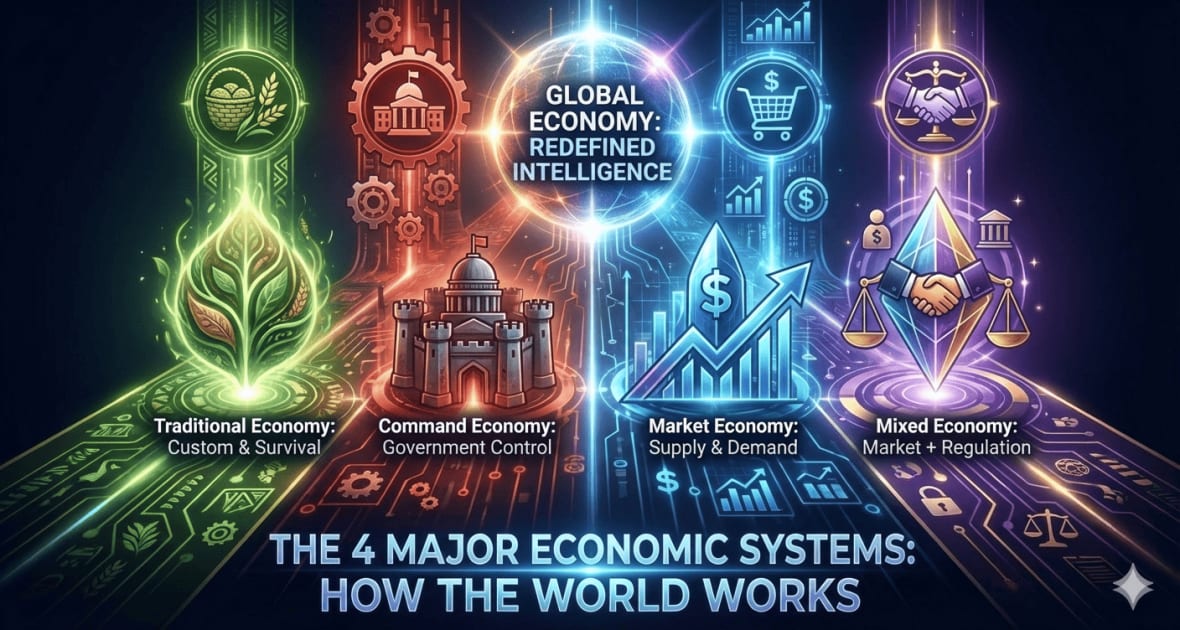
Across the globe, nations choose their path based on their history, resources, and politics. Most of them fall into four main categories. Let’s break them down in plain English.
1. The Traditional Economy: Living by the "Old School" Rules
This is the oldest system in history, and it is all about survival.
- The Vibe: "We do it this way because our ancestors did."
- How it works: You won't find complex technology or government planning here. People hunt, fish, grow food, and make goods exactly the same way previous generations did. Jobs are usually decided by family roles or community customs.
- Where you find it: Mostly in remote, rural areas, tribal regions, or small farming communities.
- The Trade-off: The community bonds are super strong, but there is very little economic growth or innovation.
2. The Market Economy: Powered by Your Wallet (Supply & Demand)
This system is driven by you (the consumer) and the businesses competing for your money.
- The Vibe: "May the best product win."
- How it works: The government stays mostly out of the way. Prices go up or down based on supply and demand. If you want more smartphones, companies will rush to make them to make a profit.
- The Real-World Engine: Think about the tech industry. Why do phones get thinner and faster every year? Because Apple, Samsung, and Google are in a fierce competition to capture your spending. This constant innovation, driven solely by the profit motive, is the defining characteristic of a market economy. It creates massive wealth and consumer choice.
- Where you find it: The United States and the United Kingdom are the prime examples of this system.
- The Trade-off: It is amazing for innovation and giving you lots of choices. However, without rules, it can lead to a big gap between the rich and the poor, and businesses might ignore things like pollution or worker safety to cut costs.
3. The Command Economy: When the Government is the Boss
In this system, the "free market" doesn't exist. The government controls the show.
- The Vibe: "All for one, guided from the top."
- How it works: The government makes every major decision: what to produce, how much to make, and what price to sell it at. Most factories and industries are owned by the state, not private business owners. The goal isn't profit—it's to distribute resources equally.
- The Human Cost: While the system theoretically reduces inequality, it often fails to meet consumer needs. If a central planner decides the nation needs 100,000 tractors but only 10,000 pairs of decent shoes, that's what gets made, leading to long lines and widespread shortages of everyday goods.
- Where you find it: North Korea is the main modern example, similar to the historical Soviet Union.
- The Trade-off: It can ensure everyone gets basic needs met. But, because there is no competition, there is often a lack of motivation, slow innovation, and overall low quality of goods.
4. The Mixed Economy: The Reality Check (Balance)
This is the most common system in the modern world because it tries to find the "sweet spot" between freedom and control.
- The Vibe: "Freedom... with safety rails."
- How it works: It combines the Market and Command systems. Businesses are free to operate and make money (the market part), but the government steps in to regulate big things like food safety, minimum wage, and infrastructure (the command part).
- Relatable Examples: When you go to a private doctor but the hospital has to comply with government safety standards, that's the mixed economy at work. When you use a private car to drive on a government-funded public highway, that's the mixed economy at work. The government uses tax money from private profits to provide public goods like police, schools, and national defense.
- Where you find it: Major nations like India, Germany, France, and Japan use this model.
- The Trade-off: It is a constant tug-of-war. Politicians and citizens constantly argue over where the "sweet spot" is. Should the government tax more to fund better healthcare, or should it tax less to encourage more private business growth? This debate is the core of modern politics.
Why Should You Care?
It might seem like just theory, but these systems shape your daily reality. They determine your job opportunities, how much you get paid, the cost of your groceries, and the quality of your public schools. They influence how societies grow, how wealth is shared, and how governments respond to crises.
Conclusion: One World, Different Economic Paths
The world runs on these four major economic systems—traditional, market, command, and mixed. While their structures differ wildly, each system reflects the core values and priorities of the society that chooses it.
Today, the overwhelming majority of countries have settled on the Mixed Economy. It is an ongoing attempt to harness the powerful engine of free-market innovation while ensuring a basic safety net and social services for all citizens.
Understanding how these systems work is key to understanding global development, political debates, and your own personal role in the world's economy.